"Volumeguide 2, your ultimate hub for fashion, hobbies and inspiration needed to find freedom to grow, be inspired and get motivated into an overflowing life."

Posts tagged ‘faith’

The Song that saved a Nation


Forever You reign…
Forever You reign…

The Song of Moses appears in two main places in the Bible: Exodus 15:1–18 (after crossing the Red Sea) and Deuteronomy 32:1–43 (Moses’ final song before his death).

God gave Moses the song found in Deuteronomy 32:1–43, as a testimony and a teaching tool for His people. It was more than poetry; it was a divine message set to music so it could be remembered, sung, and passed down through generations.

Here’s a breakdown of why God gave Moses the song:


1. To Serve as a Witness Against Forgetfulness (Deuteronomy 31:19–22)

God told Moses to write the song “so that it may be a witness for Me against the Israelites.”
He knew that once the people entered the Promised Land and prospered, they might forget Him and turn to idols.
The song would remind them of their covenant, calling them back when they strayed.

“This song will testify against them, for it will not be forgotten by their descendants.” — Deut. 31:21


2. To Teach Future Generations About God’s Faithfulness and Justice

The song tells Israel’s story, from God’s care and deliverance to their rebellion, and finally His mercy and restoration.
It was meant to help every generation understand who God is, faithful, just, and merciful, even when His people fail.

The song was both warning and worship, history and prophecy, a reminder that God’s justice and love always stand firm.


3. To Stir Repentance and Renew Devotion

When the people sang or heard the song, it was meant to convict their hearts and turn them back to God.
It reminded them that the same God who disciplines also redeems, that His covenant love never ends.

The melody of repentance leads to the harmony of restoration.


4. To Glorify God’s Name Among the Nations

The final verses (Deut. 32:43) call all nations to rejoice with God’s people.
The song pointed to a time when God’s salvation would reach the ends of the earth, showing His greatness beyond Israel.

“Rejoice, you nations, with His people, for He will avenge the blood of His servants and make atonement for His land and people.” — Deut. 32:43


So in essence, God gave Moses the song as a living reminder, a melody of truth that would outlast generations, bringing His people back to Him whenever they wandered.

“You Reign Forever” (Short Worship Version)


You split the sea, you made a way,
Turned my night into a glorious day.
Your strong hand lifted me high,
Now freedom’s song fills the sky.


Who is like You, O Lord?
Holy and mighty forevermore.
You lead with love, Your mercy remains —
You reign forever, You reign!


You are the Rock — unchanging, true,
All creation belongs to You.
Rejoice, O nations! Lift His name —
Our God of glory reigns!


You will get a sense of how the song goes. It seems to be a long song.

Sing this short version as you like during your worship

Read the long version in your study time to get a deeper meaning.

Simple Inspiration for a Purposeful Life

Simple Inspiration for a Purposeful Life

In a world filled with noise and constant motion, it’s easy to feel like purpose is something far away, something we must chase, earn, or somehow prove ourselves worthy of. But what if living a purposeful life isn’t about doing more? What if it’s about finding meaning in the simple things we already have?

Purpose begins with presence.
It’s in the quiet moments before the day begins, a whispered prayer, a cup of coffee enjoyed slowly, or the sunlight streaming through your window. These small moments are gentle reminders that God is near and that life’s true purpose isn’t always found in grand plans, but in daily faithfulness.

Here are a few simple ways to find inspiration in your everyday life:

1. Begin each day with gratitude.
Start by thanking God for where you are right now. Gratitude opens the door to peace and helps you see purpose in even the smallest blessings.

2. Create with intention.
Whether it’s through art, words, cooking, or caring for others, your creativity is a reflection of God’s creative nature. Use your gifts, no matter how small they may seem, to bring beauty and encouragement into the world.

3. Be kind to yourself and others.
Living purposefully doesn’t mean perfection. It’s about grace, giving it, receiving it, and extending it to those around you. Sometimes, the most purposeful thing you can do is simply show love in an ordinary moment.

4. Slow down and listen.
God often speaks in stillness. When you quiet your heart, you begin to notice how He’s guiding you, through Scripture, through nature, and through the gentle rhythm of your day.

5. Keep your eyes on what matters most.
When life feels cluttered or confusing, come back to this truth: You were created on purpose, for a purpose. And that purpose is rooted in love, to love God, to love others, and to live in the peace that comes from knowing you are enough in Him.

The Extension of the Olive Branch

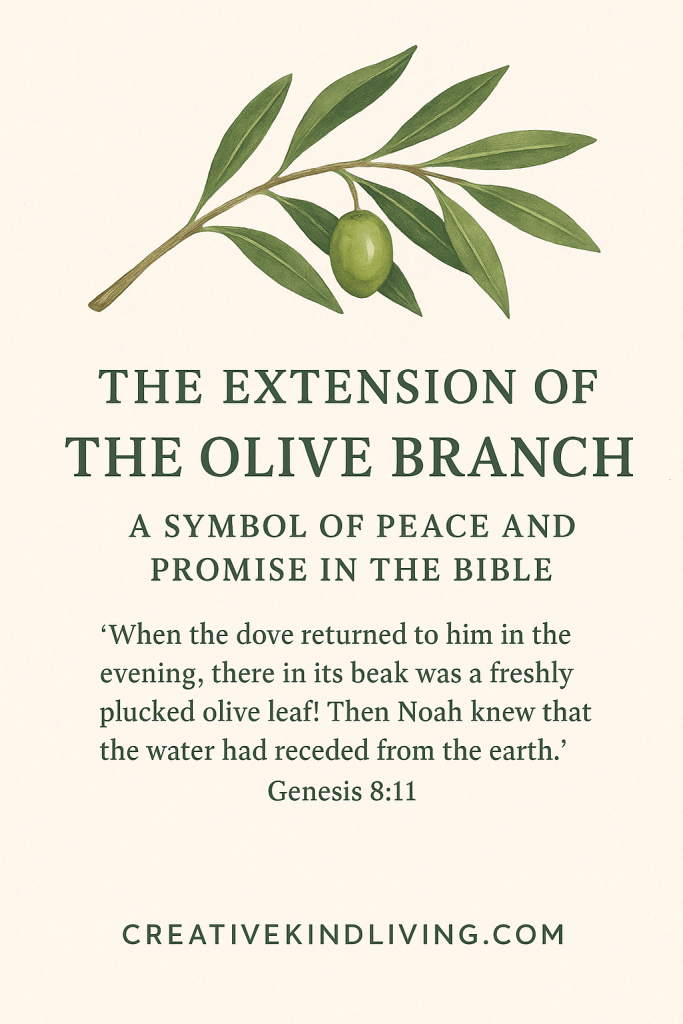
The Extension of the Olive Branch: A Biblical Symbol of Peace and Promise

In a world often marked by conflict, division, and misunderstanding, the image of an olive branch still carries profound meaning. It’s more than just a symbol of peace; it’s a reminder of God’s mercy, renewal, and the promise of a fresh start.

The First Olive Branch: A Sign of Hope

The olive branch first appears in Scripture in Genesis 8:11, when Noah releases a dove from the ark after the flood. The Bible says:

“When the dove returned to him in the evening, there in its beak was a freshly plucked olive leaf! Then Noah knew that the water had receded from the earth.” Genesis 8:11 (NIV)

This simple yet powerful moment marks a turning point in history. The flood had wiped away corruption, and now, through this delicate leaf, God was showing that new life had begun. The olive branch was a sign that His judgment had passed and His mercy was present.

It wasn’t just a sign for Noah; it was a symbol for all humanity. The olive leaf told the story of restoration. It said, “God is not finished. There’s still hope.”

Olive Branches and God’s Covenant

Later in Scripture, the olive tree became a recurring image of God’s relationship with His people. The psalmist writes,

“I am like a green olive tree in the house of God; I trust in the mercy of God forever and ever.” Psalm 52:8 (NKJV)

Here, the olive tree represents a person rooted in God’s presence, flourishing, steadfast, and fruitful. Extending an olive branch to someone else, then, becomes more than a gesture of peace; it’s an act of godly character. It mirrors the mercy God extends to us daily.

Jesus and the Olive Tree

The olive tree continues to appear throughout the New Testament, even in the Garden of Gethsemane, a name that literally means “oil press.” There, among the olive trees, Jesus prayed before His crucifixion. It was the place where the Prince of Peace was pressed in spirit, preparing to extend the greatest act of peace ever known, reconciliation between God and humanity.

Through His sacrifice, Jesus became the ultimate “olive branch” extended to us, a divine invitation to be made right with God and with one another.

Extending the Olive Branch Today

When we choose to forgive, to reach out in love, or to mend broken relationships, we follow in God’s footsteps. Extending the olive branch means laying down pride and picking up peace.

It’s not always easy, but it’s always powerful. In doing so, we become vessels of restoration, carrying forward the same spirit that brought hope to Noah, mercy to Israel, and salvation to us through Christ.

“Blessed are the peacemakers, for they shall be called children of God.”Matthew 5:9

A Final Reflection

The olive branch isn’t just a piece of history; it’s a calling. It invites us to live as people who bring peace wherever we go. Whether that’s offering forgiveness, showing compassion, or simply listening with love, every act of peace plants a new seed of hope.

Just as the dove brought an olive branch to Noah, we too can carry the message that the floodwaters have receded, that new beginnings are possible through God’s grace.


Reflection Question:
Who in your life might need you to extend an olive branch today; and how can you show them the peace of Christ?

Living a Lifestyle of Faith

Faith isn’t just something we practice on Sunday. It’s woven into the everyday moments of our lives.

It’s choosing prayer over worry.
It’s speaking kindness when it’s easier to stay silent.
It’s trusting God’s plan when the path feels uncertain.
It’s finding joy in simple blessings and hope in the hardest seasons.

A lifestyle of faith is about letting God’s love guide how we think, create, speak, and live every single day.

What does “living by faith” look like in your daily life? Share below. I’d love to hear your heart.

#FaithLifestyle #WalkByFaith #CreativeKindLiving

Understanding how the Holy Spirit Works in the Life of a Believer


1. Gifts of the Spirit (Charismata)

Definition:
The gifts of the Spirit are special abilities, empowerments, or manifestations given by the Holy Spirit to believers for the building up of the church and the advancement of God’s kingdom.

Key Texts:

  • 1 Corinthians 12:4–11 – Paul lists gifts such as wisdom, knowledge, faith, healing, miracles, prophecy, discernment, tongues, and interpretation.
  • Romans 12:6–8 – Other gifts include serving, teaching, encouragement, giving, leadership, and mercy.
  • Ephesians 4:11–12 – Mentions apostles, prophets, evangelists, pastors, and teachers given for equipping the saints.

Purpose:

  • They are not for self-exaltation, but for the edification of others (1 Cor. 12:7).
  • They differ among believers—no one person has all gifts, and not everyone has the same gift.
  • They are temporary empowerments, granted as the Spirit wills, for ministry, service, and the church’s mission.

Summary: Gifts are about what you do through the Spirit to serve others.


2. Fruit of the Spirit (Karpos)

Definition:
The fruit of the Spirit refers to the character and virtues produced in a believer’s life as they walk in step with the Spirit.

Key Text:

  • Galatians 5:22–23 – Paul lists love, joy, peace, patience, kindness, goodness, faithfulness, gentleness, and self-control.

Purpose:

  • Unlike gifts, the fruit is not about ability, but about character transformation.
  • It reflects the likeness of Christ formed in us over time (John 15:4–5).
  • The fruit is expected to grow in every believer’s life, not just some.

Summary: Fruit is about who you are in Christ, as the Spirit shapes your heart and conduct.


3. Key Differences at a Glance

AspectGifts of the SpiritFruit of the Spirit
FocusService & ministryCharacter & maturity
Given toVaries—distributed individually as the Spirit willsExpected in all believers
PurposeTo build up the church & witness to the worldTo reflect Christ & grow in holiness
NatureInstant empowermentGradual growth
ExampleGift of teaching, prophecy, healingLove, patience, self-control

In short:

  • Gifts show the power of the Spirit at work through us.
  • Fruit shows the presence of the Spirit at work within us.

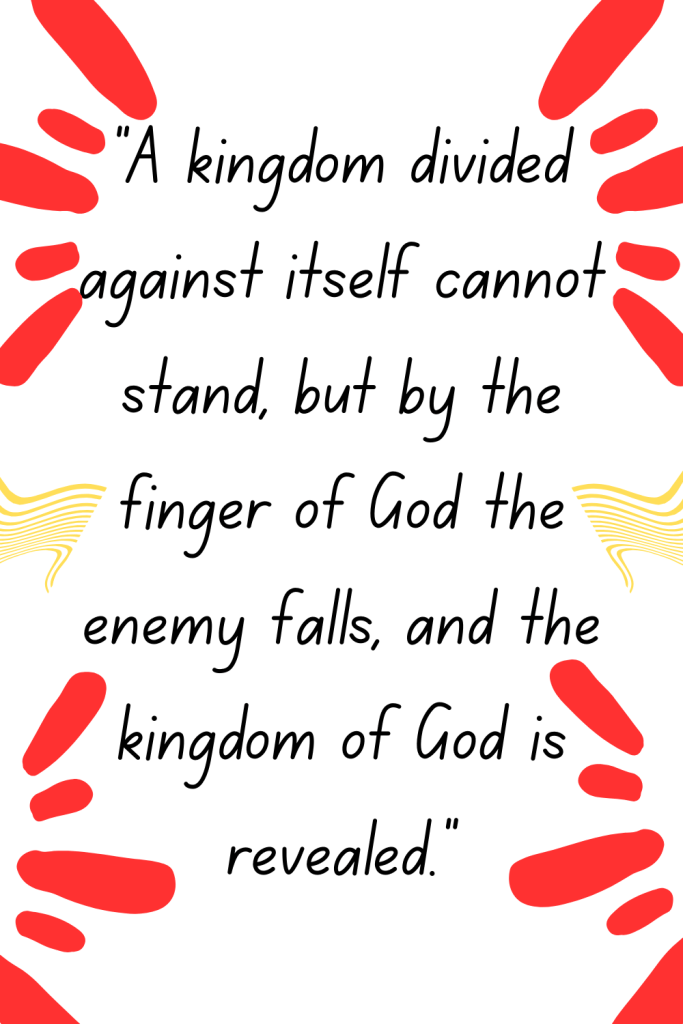
“A Kingdom Divided Cannot Stand: Understanding Luke 11:17–20”

Division has always been one of the greatest threats to strength and stability. Whether in nations, families, or even within our own hearts, disunity creates weakness that cannot endure. In Luke 11:17-20, Jesus confronts this truth head-on as He responds to those who accused Him of using Satan’s power to cast out demons. His words remind us that unity is essential and that true authority comes only from God. In this passage, we discover both a warning against division and a powerful assurance that God’s kingdom is greater than any force of darkness.

Outline For A Devotional Or A Mini-Sermon

1. Introduction

  • Set the stage: Jesus is accused of using Satan’s power to cast out demons.
  • Highlight the main theme: division destroys, but God’s power unites and overcomes.

2. A Warning Against Division (Luke 11:17)

  • “Every kingdom divided against itself is laid waste, and a divided household falls.”
  • Explain how division weakens nations, families, churches, and even individuals.
  • Application: where do we see division in our own lives or communities today?

3. It would be unreasonable for satan to be against himself (Luke 11:18–19)

  • Jesus shows the illogic: Satan would not fight against himself.
  • Point out how lies and accusations often come when the truth is uncomfortable.
  • Application: discern where false accusations or confusion come from in our spiritual battles.

4. The Finger of God (Luke 11:20)

  • The “finger of God” recalls Exodus 8:19, when Pharaoh’s magicians admitted God’s power.
  • This shows God’s kingdom had broken into the world through Jesus.
  • Application: the same power of God is still at work in our lives, bringing freedom and victory.

5. Living in God’s Kingdom Today

  • Division leads to destruction, but Christ calls us to unity in Him.
  • God’s power overcomes fear, doubt, and spiritual darkness.
  • Application: practical steps to invite God’s unity into family, faith, and daily life.

6. Conclusion & Reflection

The truth is: “A kingdom divided cannot stand, but the kingdom of God endures forever.”

Can you examine areas of division in your life and surrender them to Christ?


Pray

  • Prayer: A short prayer for unity and God’s power in our lives

God’s Clear Instructions: 5 Biblical Examples


5 Biblical Examples

Study how God gave specific, detailed directions to His people and how obedience shaped His divine plan.


1. Noah and the Ark

Scripture: Genesis 6:14–16
Instruction Given:
God told Noah to build an ark with exact measurements, materials (gopher wood), and design (three decks, a window, and a door).

Reflection Questions:

  • Why do you think God was so specific with the ark’s design?
  • What can we learn about obedience from Noah’s response?

2. Moses and the Exodus

Scripture: Exodus 3:10
Instruction Given:
God called Moses to go to Pharaoh and lead the Israelites out of Egypt.

Reflection Questions:

  • What fears did Moses have about this task?
  • How does God equip us when He gives us hard instructions?

3. Joshua and the Fall of Jericho

Scripture: Joshua 6:3–5
Instruction Given:
March around Jericho once for six days, then seven times on the seventh day with trumpets before the walls would fall.

Reflection Questions:

  • Why might God have used such an unusual battle plan?
  • What does this teach us about trusting God’s process?

4. Elijah by the Brook

Scripture: 1 Kings 17:3–4
Instruction Given:
God told Elijah to hide in the Kerith Ravine, drink from the brook, and wait for ravens to feed him.

Reflection Questions:

  • How did God provide for Elijah in this hidden place?
  • What does this show us about God’s care in seasons of waiting?

5. Disciples Preparing the Passover

Scripture: Luke 22:8–12
Instruction Given:
Jesus told Peter and John where to go, whom to meet, and how to prepare the Passover meal.

Reflection Questions:

  • Why did Jesus give such detailed steps for the Passover?
  • What does this moment tell us about preparation in God’s timing?

Personal Application

  • Has God ever given you a clear instruction or nudge in your heart?
  • How can you become more attentive and obedient to His voice in your daily life?

A Nation Under God

A Nation Under God

Few stories shine as brightly as the history of our great nation. Woven together with courage, sacrifice, and faith, the United States was founded on principles that echo the heart of freedom, life, liberty, and the pursuit of happiness.

From the first settlers who crossed oceans seeking religious liberty, to the brave hearts who stood on battlefields defending that liberty, we have been a people called to stand for truth and justice. Though our journey has not been perfect, we continue to press forward, leaning not on our own understanding, but on the faith that guided our forefathers.

Our strength is not found solely in our might or wealth, but in the moral compass that points us to God. When we honor Him, we flourish. When we walk in humility and justice, we shine as a beacon of hope to the world.

Today, as we face new challenges and uncertain tomorrows, may we remember who we are and whose we are. Let us recommit to being a nation under God, not just in name, but in heart. Let us live with integrity, pray with boldness, and serve with love. For only with His guidance and presence can we truly thrive.

Let us pray, A Prayer for Our Nation

Heavenly Father,

We thank You for the gift of this great land, a place of promise, opportunity, and freedom. You have blessed us beyond measure, and we humbly acknowledge that every good thing we have comes from Your hand.

Lord, we ask for Your guidance today. As a nation, we need Your wisdom in our leaders, Your peace in our communities, and Your healing in our hearts. Help us to turn from division and pride, and to walk instead in unity and humility. Restore what has been broken, renew what has been forgotten, and revive our hearts to seek You first.

Let Your presence be felt from the highest office to the smallest home. May Your truth guide our decisions, Your love shape our actions, and Your Spirit move mightily among us.

God, bless America, not for our own glory, but so that we might be a light to the world, a people known by our love, and a nation that honors You in all we do.

In Jesus’ name,
Amen.

Image

God wants you to know

God’s Promises of Healing