"Volumeguide 2, your ultimate hub for fashion, hobbies and inspiration needed to find freedom to grow, be inspired and get motivated into an overflowing life."

Posts tagged ‘christian encouragement’

The Act of Grace: Saved, Strengthened, and Sent

THE ACT OF GRACE

Grace is more than a word we hear in church. Grace is an act of God that changes our lives.

We often think of grace as God’s unmerited favor—and it is. But Scripture shows us that grace does something. Grace reaches for us when we cannot save ourselves. Grace teaches us, strengthens us, builds us up, and gives us the courage to keep moving forward.

Paul’s words in Acts 20:24 reveal the power of a life surrendered to God’s grace:

“But none of these things move me, neither count I my life dear unto myself, so that I might finish my course with joy, and the ministry, which I have received of the Lord Jesus, to testify the gospel of the grace of God.”

Paul understood that his life was not about comfort or convenience. He had received a ministry from Christ, and he wanted to finish the assignment God had given him.

Grace Gives Us Something Worth Living For

Paul had experienced hardship, opposition, and uncertainty. Yet he did not allow those things to become greater than his purpose.

He said, “none of these things move me.”

That is what grace can do in our lives.

Grace does not promise that we will never experience difficulty. Instead, grace gives us the strength to continue when difficulty comes.

There will be moments when we feel tired, disappointed, misunderstood, or uncertain about what comes next. But God’s grace reminds us that our story is bigger than the difficulty we are facing.

We can keep going because God has given us something worth living for.

Grace Builds Us Up

Later in the same chapter, Paul said:

“And now, brethren, I commend you to God, and to the word of his grace, which is able to build you up…” — Acts 20:32

Notice those words: “the word of his grace, which is able to build you up.”

Grace doesn’t leave us where it finds us.

God’s grace builds.

It builds our faith when we are discouraged.
It builds our confidence in God when circumstances are uncertain.
It builds our understanding when we study His Word.
It builds us when we have fallen and need to get back up.

Sometimes we look at ourselves and see everything that needs to be fixed. God looks at us through His grace and sees what He is still building.

You may not be where you want to be, but that does not mean God has finished with you.

Romans 3: Grace Meets Us Where We Are

Romans 3 brings us face-to-face with an important truth about humanity:

“For all have sinned, and come short of the glory of God.” — Romans 3:23

Every person has fallen short.

That means none of us can stand before God and claim that we earned salvation through our own goodness.

Our accomplishments cannot save us.
Our reputation cannot save us.
Our possessions cannot save us.
Our religious activities cannot save us.

We need grace.

Romans 3 continues by explaining that we are “justified freely by his grace through the redemption that is in Christ Jesus” (Romans 3:24).

This is the beautiful act of grace.

We were unable to make ourselves righteous, so God provided a way through Jesus Christ.

Grace does not tell us that sin does not matter. Grace tells us that God loved us enough to provide redemption from sin.

Grace Is a Gift, Not a Reward

A reward is something we receive because we have earned it.

Grace is different.

Grace is God’s undeserved favor.

That is why there is no room for boasting. Romans 3:27 asks:

“Where is boasting then? It is excluded.”

We cannot take credit for what God has done.

Salvation is not a trophy we earned. It is a gift we received.

This should produce humility, gratitude, and a desire to live differently.

Grace Changes How We Live

Grace is not permission to remain the same.

When we truly understand God’s grace, we begin to see our lives differently.

We become more willing to forgive because we have been forgiven.

We become more willing to serve because Christ served us.

We become more willing to extend compassion because God extended compassion toward us.

We become more willing to follow God’s calling because we understand that our lives belong to Him.

Paul’s life demonstrates this beautifully. He received grace, and then he received an assignment.

Grace saved him.
Grace strengthened him.
Grace sent him.

The Act of Grace

The act of grace is not simply something God did in the past. Grace continues to work in the life of the believer.

When you are weak, grace strengthens you.

When you fall, grace calls you back.

When you don’t know what to do, God’s Word gives you direction.

When you feel unworthy, remember that your righteousness does not come from yourself—it comes through Christ.

And when God gives you an assignment, grace gives you what you need to continue.

You may not know how every chapter of your life will unfold. But you can trust the God who is writing the story.

Paul wanted to “finish my course with joy.”

That can be our prayer too:

“Lord, help me receive Your grace, walk in Your grace, grow through Your grace, and finish the course You have given me.”

Grace for Today

Perhaps you are carrying something today that makes you feel like giving up.

Remember Acts 20:32:

“The word of his grace… is able to build you up.”

Let God’s Word build you.

Let His grace remind you that your past does not have to determine your future.

Let His grace teach you.

Let His grace strengthen you.

Let His grace send you forward.

You do not have to earn God’s love.

You do not have to prove yourself worthy of salvation.

Jesus Christ is the reason grace is available to you.

Romans 3 reminds us that all have sinned, but it also points us toward the redemption God freely provides through Christ.

So today, receive His grace.

Walk in His grace.

And when God gives you an opportunity to encourage someone else, extend that same grace.

Grace received becomes grace lived.

A Prayer for Grace

Father, thank You for Your amazing grace. Thank You for sending Jesus Christ to provide redemption when I could never earn it on my own. Help me to understand Your grace more deeply and allow Your Word to build me up. Give me strength to continue the course You have placed before me. Help me walk humbly, love others, forgive freely, and live as a testimony of Your grace. May my life bring glory to You. In Jesus’ name, Amen.

Scripture to Remember:
“And now, brethren, I commend you to God, and to the word of his grace, which is able to build you up.” — Acts 20:32


Faith Over Feelings

Living by What You Believe, Not What You See

Faith often asks us to trust when everything around us say otherwise. Our feelings can shift with circumstances, joy one moment, worry the next, but faith stays anchored in truth, not emotion.

When life feels uncertain, our emotions try to take control. But Scripture reminds us, “We walk by faith, not by sight” (2 Corinthians 5:7). Faith is believing in God’s promises even when you can’t see them yet. It’s choosing trust over doubt and peace over panic.

Living by faith over feelings doesn’t mean pretending everything’s okay; it means surrendering every emotion to God and letting His Word lead your heart. When fear rises, speak His truth. When confusion sets in, rest in His presence.

God is at work within you

God at Work Within You: Trusting His Purpose in Every Season

Have you ever felt unsure about where you’re headed, or questioned if you have what it takes to fulfill what’s been placed on your heart? Those moments of doubt are familiar to all of us, but Philippians 2:13 offers an incredible reminder that we’re not walking this path alone.

“For it is God who works in you to will and to act in order to fulfill His good purpose.”
Philippians 2:13 (NIV)

This verse shifts the focus from our own ability to God’s power at work within us. It reminds us that the good desires, ideas, and actions stirring in our hearts are not just our own; they are divinely inspired. When we choose to follow God, He doesn’t simply hand us a purpose and walk away; He stays involved every step of the way, shaping our will and empowering our actions to align with His plan.

You’re Not Doing This Alone

So often, we feel the pressure to make everything happen by our own strength. But Philippians 2:13 assures us that God Himself is the one working behind the scenes, guiding our thoughts, adjusting our motives, and giving us the courage to move forward. Even when we feel stuck or uncertain, He is gently steering us toward His good purpose.

God’s work within us isn’t always loud or obvious. Sometimes it looks like patience when you’d rather rush, forgiveness when you’d rather hold on, or peace in the middle of what seems impossible. In those moments, His quiet power is transforming your heart and teaching you to trust Him more deeply.

Trust the Process

We all love quick results, but spiritual growth takes time. God’s work in you is a process, one that involves surrender, faith, and perseverance. Each season, even the hard ones, plays a part in fulfilling His greater plan for your life. What may feel like a delay is often preparation.

When you can’t see the full picture, rest in the truth that God can. He knows how to bring beauty out of uncertainty and purpose out of every challenge.

Final Thoughts

Philippians 2:13 isn’t just encouragement, it’s empowerment. It means that as long as you’re willing, God will do the rest. He will shape your desires, strengthen your actions, and ensure that your life aligns with His purpose.

You may not always understand how, but you can trust that He’s working. Right now. Right where you are.

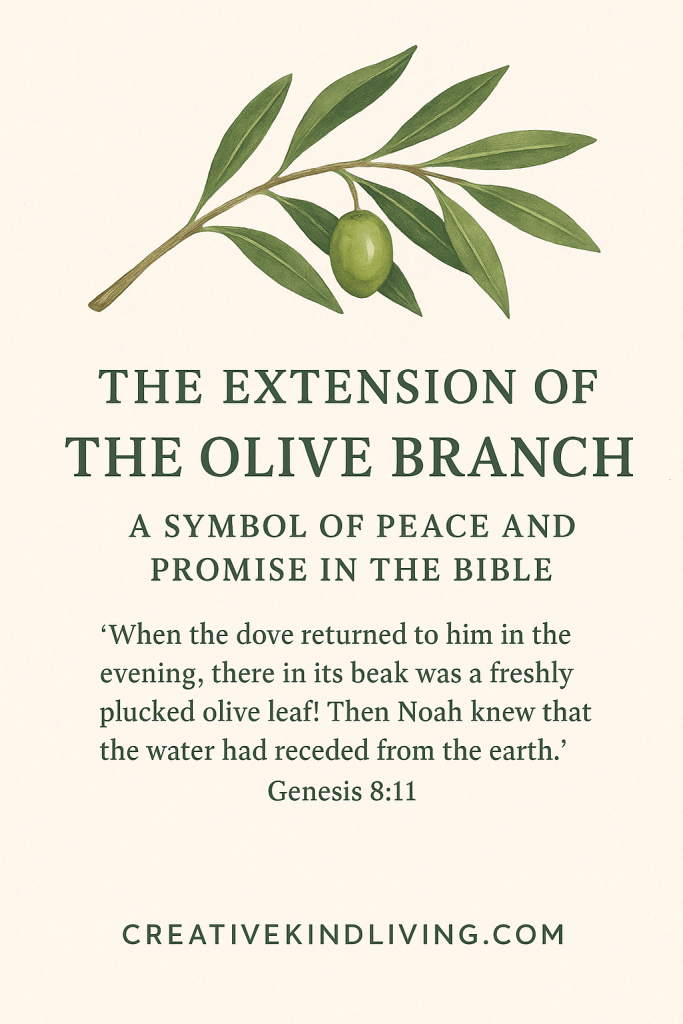
The Extension of the Olive Branch

The Extension of the Olive Branch: A Biblical Symbol of Peace and Promise

In a world often marked by conflict, division, and misunderstanding, the image of an olive branch still carries profound meaning. It’s more than just a symbol of peace; it’s a reminder of God’s mercy, renewal, and the promise of a fresh start.

The First Olive Branch: A Sign of Hope

The olive branch first appears in Scripture in Genesis 8:11, when Noah releases a dove from the ark after the flood. The Bible says:

“When the dove returned to him in the evening, there in its beak was a freshly plucked olive leaf! Then Noah knew that the water had receded from the earth.” Genesis 8:11 (NIV)

This simple yet powerful moment marks a turning point in history. The flood had wiped away corruption, and now, through this delicate leaf, God was showing that new life had begun. The olive branch was a sign that His judgment had passed and His mercy was present.

It wasn’t just a sign for Noah; it was a symbol for all humanity. The olive leaf told the story of restoration. It said, “God is not finished. There’s still hope.”

Olive Branches and God’s Covenant

Later in Scripture, the olive tree became a recurring image of God’s relationship with His people. The psalmist writes,

“I am like a green olive tree in the house of God; I trust in the mercy of God forever and ever.” Psalm 52:8 (NKJV)

Here, the olive tree represents a person rooted in God’s presence, flourishing, steadfast, and fruitful. Extending an olive branch to someone else, then, becomes more than a gesture of peace; it’s an act of godly character. It mirrors the mercy God extends to us daily.

Jesus and the Olive Tree

The olive tree continues to appear throughout the New Testament, even in the Garden of Gethsemane, a name that literally means “oil press.” There, among the olive trees, Jesus prayed before His crucifixion. It was the place where the Prince of Peace was pressed in spirit, preparing to extend the greatest act of peace ever known, reconciliation between God and humanity.

Through His sacrifice, Jesus became the ultimate “olive branch” extended to us, a divine invitation to be made right with God and with one another.

Extending the Olive Branch Today

When we choose to forgive, to reach out in love, or to mend broken relationships, we follow in God’s footsteps. Extending the olive branch means laying down pride and picking up peace.

It’s not always easy, but it’s always powerful. In doing so, we become vessels of restoration, carrying forward the same spirit that brought hope to Noah, mercy to Israel, and salvation to us through Christ.

“Blessed are the peacemakers, for they shall be called children of God.”Matthew 5:9

A Final Reflection

The olive branch isn’t just a piece of history; it’s a calling. It invites us to live as people who bring peace wherever we go. Whether that’s offering forgiveness, showing compassion, or simply listening with love, every act of peace plants a new seed of hope.

Just as the dove brought an olive branch to Noah, we too can carry the message that the floodwaters have receded, that new beginnings are possible through God’s grace.


Reflection Question:
Who in your life might need you to extend an olive branch today; and how can you show them the peace of Christ?